The SCANeR 2026.1 release addresses the major challenges faced by ADAS and autonomous driving programs: integration of heterogeneous models, environment realism, campaign automation, and massive test coverage.
This version strengthens SCANeR as an open, modular, and industrial grade simulation platform, designed to seamlessly integrate into modern R&D workflows.
A More Open Architecture for Scalable Simulation Workflows
Simulation teams today must operate within multi tool environments, manage proprietary models, and rely on automated validation pipelines.
SCANeR 2026.1 continues its evolution toward a fully interoperable platform, without compromising performance or system consistency.
Python Model API: More Flexibility, Greater Accessibility
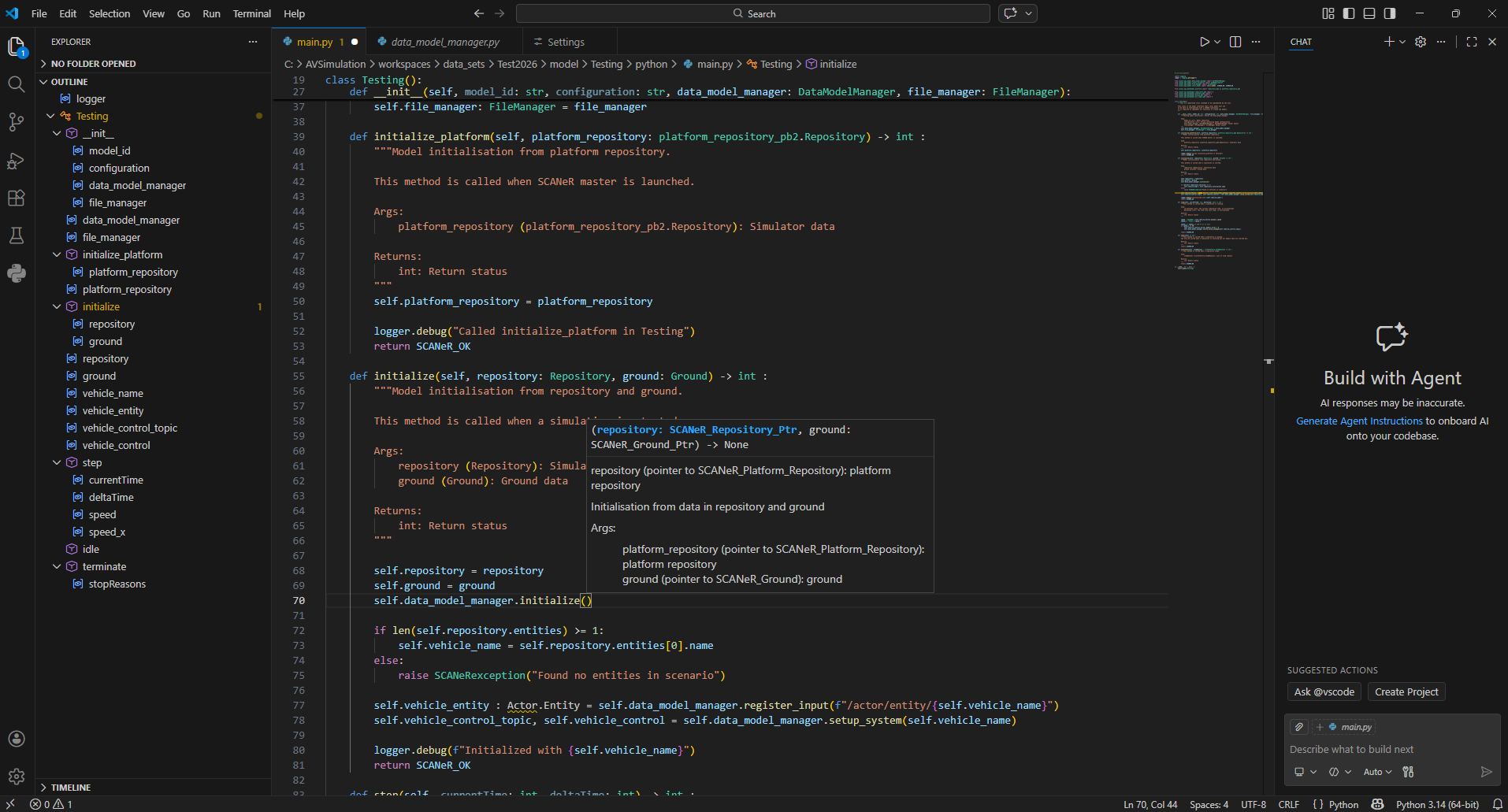
SCANeR 2026.1 introduces a new Python Model API, offering the same capabilities as the C++ API while leveraging a language widely adopted in engineering, data, and AI environments.
Key Benefits
- Flexible and adaptable for model or system development and integration
- Seamless integration with AI-based perception stacks
- Reduced complexity for industrial partners through open APIs
Target Users
Simulation engineers, ADAS and autonomy teams, data scientists.
Advanced FMU Integration: Direct Execution of External Models
SCANeR 2026.1 introduces FMU Dynamics, a new model type enabling the direct execution of vehicle dynamics and system models encapsulated as FMUs (FMI) within the SCANeR environment.
What This Enables
- Direct integration of vehicle dynamics and system models packaged as FMUs
- Native execution within the SCANeR Digital Vehicle Model
- Full consistency with the digital vehicle, sensors, and control architecture
- Elimination of complex network-based synchronization mechanisms
FMU Auto Mapping
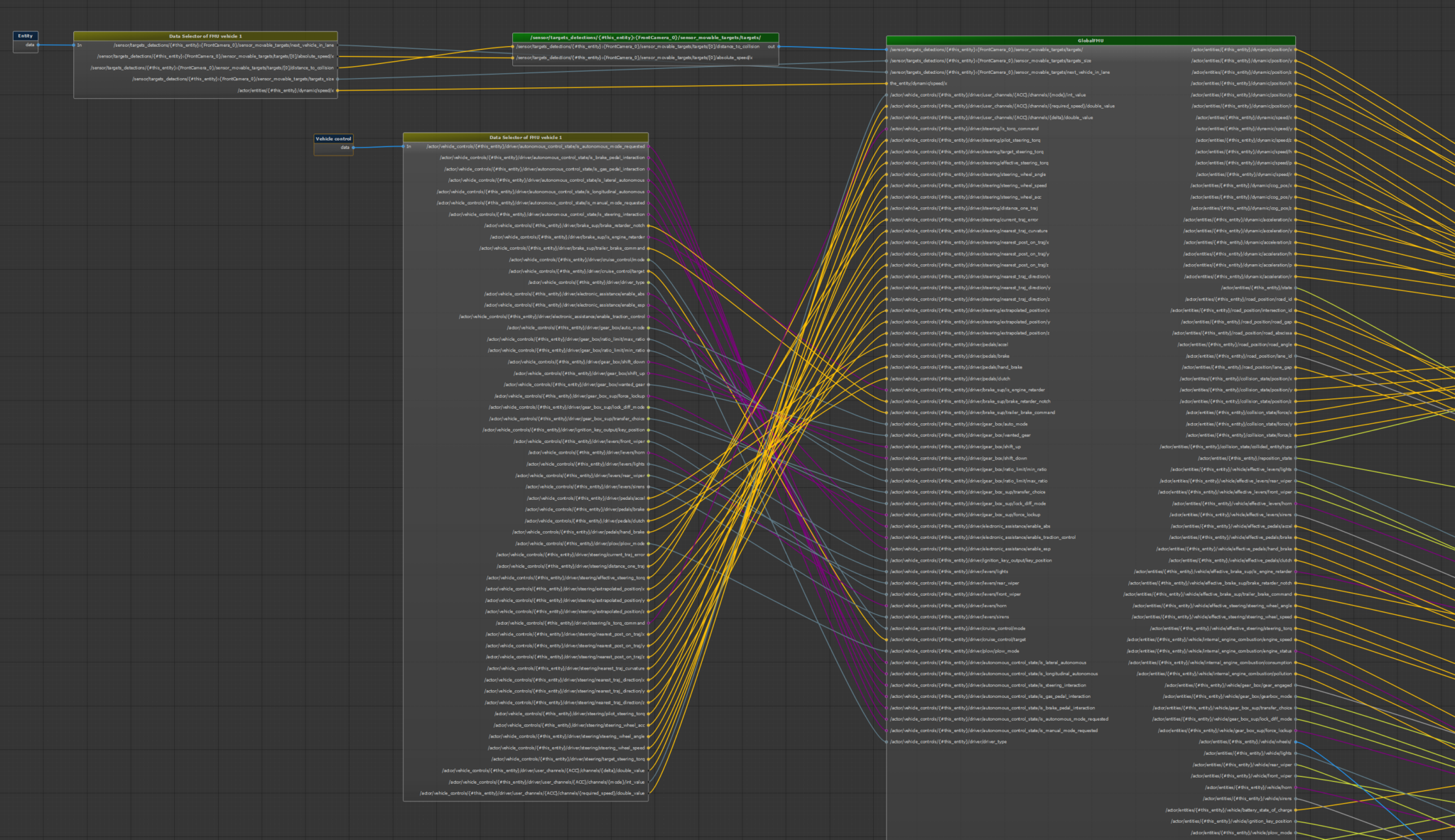
To simplify the integration of FMUs exposing a large number of signals,SCANeR 2026.1 introduces an auto mapping feature that automatically connects FMU ports to compatible SCANeR data paths.
Results
- Faster setup
- Reduced manual errors
- More robust and reproducible integrations
Guard HTTP API
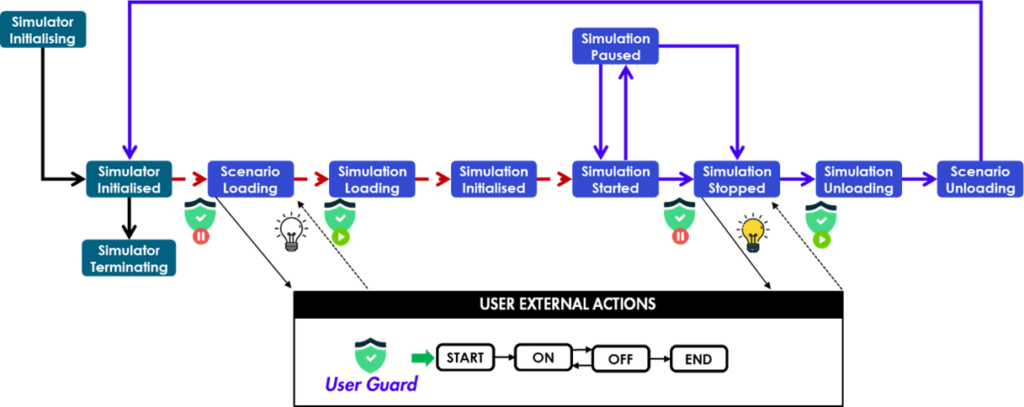
SCANeR 2026.1 introduces a Guard HTTP API, a flexible mechanism that enables external actions and conditions to temporarily block and validate transitions within the simulation state machine.
Key Use Cases
- Advanced customization of the simulation workflow
- Triggering of external hardware synchronization in XIL
- External processes execution
- Safety validation & precondition enforcement
World Modeling: Improving Realism Without Sacrificing Productivity
The quality of driving simulation results directly depends on the fidelity of the simulated world. SCANeR 2026.1 significantly improves geometric quality, particularly in critical areas, while reducing modeling effort.
Advanced Intersection Surface Generation
Intersections derived from real world data often contain elevation inconsistencies. SCANeR 2026.1 introduces a new workflow for intersection surface generation.
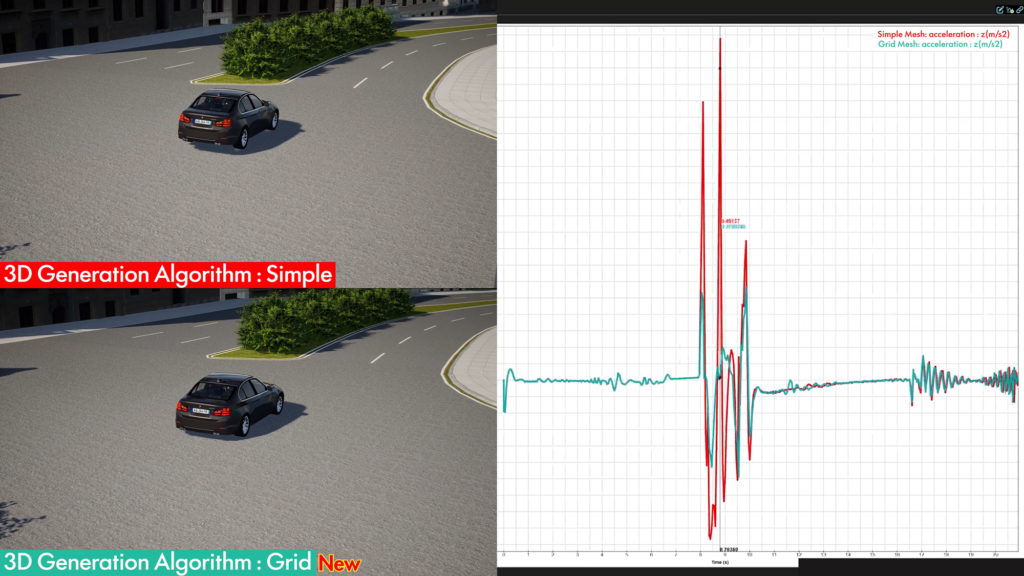
Key Contributions
- Smoother, more consistent surfaces
- Clear visualization of uneveness on trajectories
- Immediate assessment of vehicle comfort
Benefit
Early identification and correction of geometric issues before simulation campaigns.
Enhanced Procedural Generation
New procedural generation styles enable the creation of larger, more diverse, and more realistic environments, while maintaining fast and efficient workflows.
- Dutch Brick Urban Streetscape

- Early Modern US Downtown

Test Management and Coverage: Greater Efficiency at Scale
Modern ADAS and autonomous vehicle validation requires running massive simulation campaigns – often involving thousands or even millions of test cases with parameter variability (weather, speeds, distances, traffic density, sensor conditions, etc.).
However, once failures are detected, engineers do not want to rerun the entire campaign immediately. They need to isolate, analyze, fix, and validate efficiently.
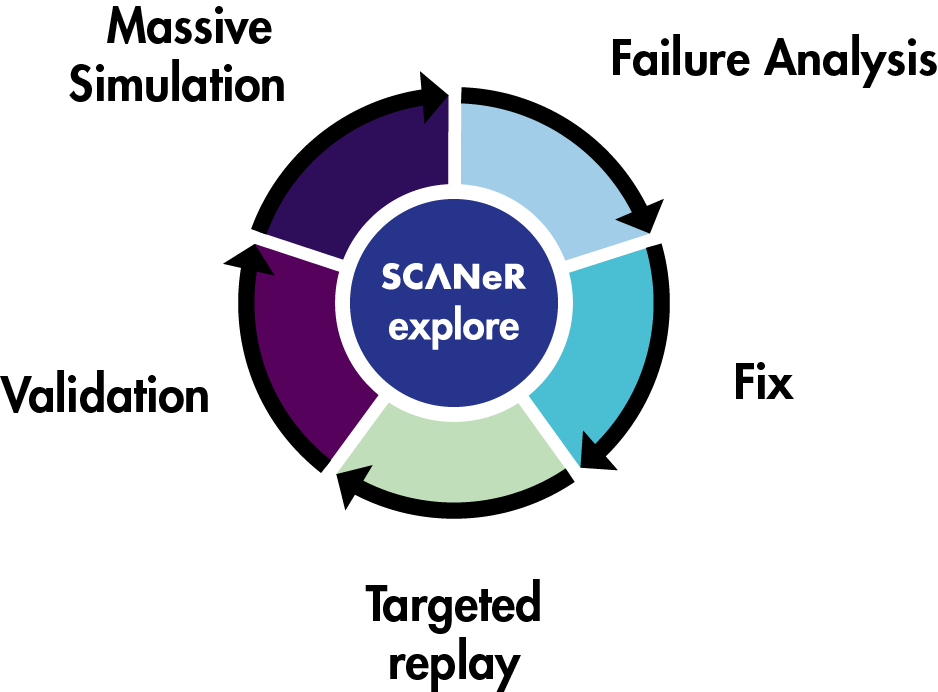
Targeted Test Case Re-Execution
In SCANeR explore, it is now possible to rerun only selected test cases individually or in groups within very large campaigns.
Benefits
- Faster failure analysis
- Reduced debugging time
- More efficient iterative validation
KPIs Available During Execution
SCANeR 2026.1 enables KPI calculation and reporting directly during simulation execution, reducing post processing activities and accelerating decision making.
UTAC Euro NCAP 2026 Pack: Anticipate new safety assessments
The UTAC Euro NCAP 2026standard introduces more scenarios and increased variability.
SCANeR 2026.1 includes a UTAC Euro NCAP 2026 Pack, available with a user trial version.
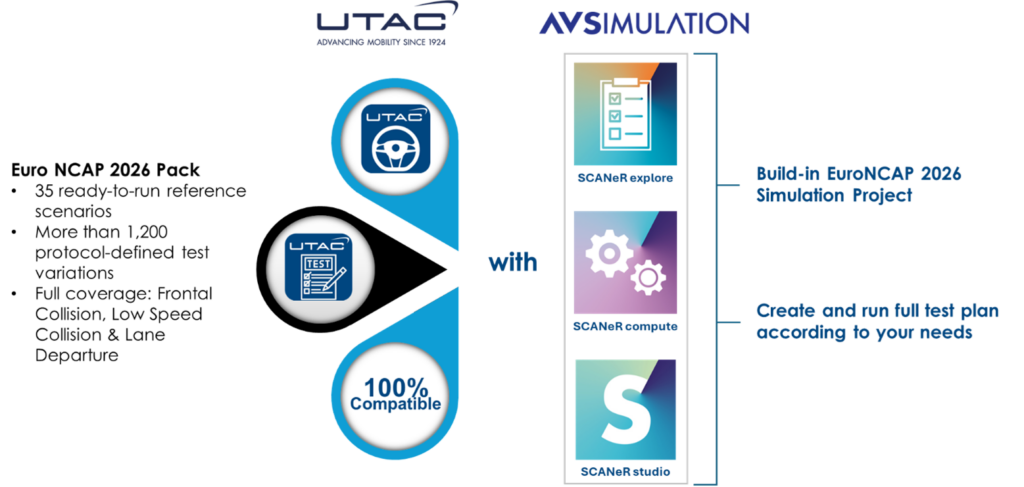
Objective : Enable teams to anticipate new protocols for safety assessments and increase validation coverage.
Why Migrate to SCANeR 2026.1 ?
- Open and interoperable simulation platform
- Simplified integration of existing models
- Enhanced environmental realism
- Faster, more targeted large‑scale validation
- Proactive preparation for UTAC Euro NCAP 2026 standards
Take the Next Step
Discover how SCANeR 2026.1 can optimize your simulation workflows and accelerate your ADAS and autonomous vehicle projects.