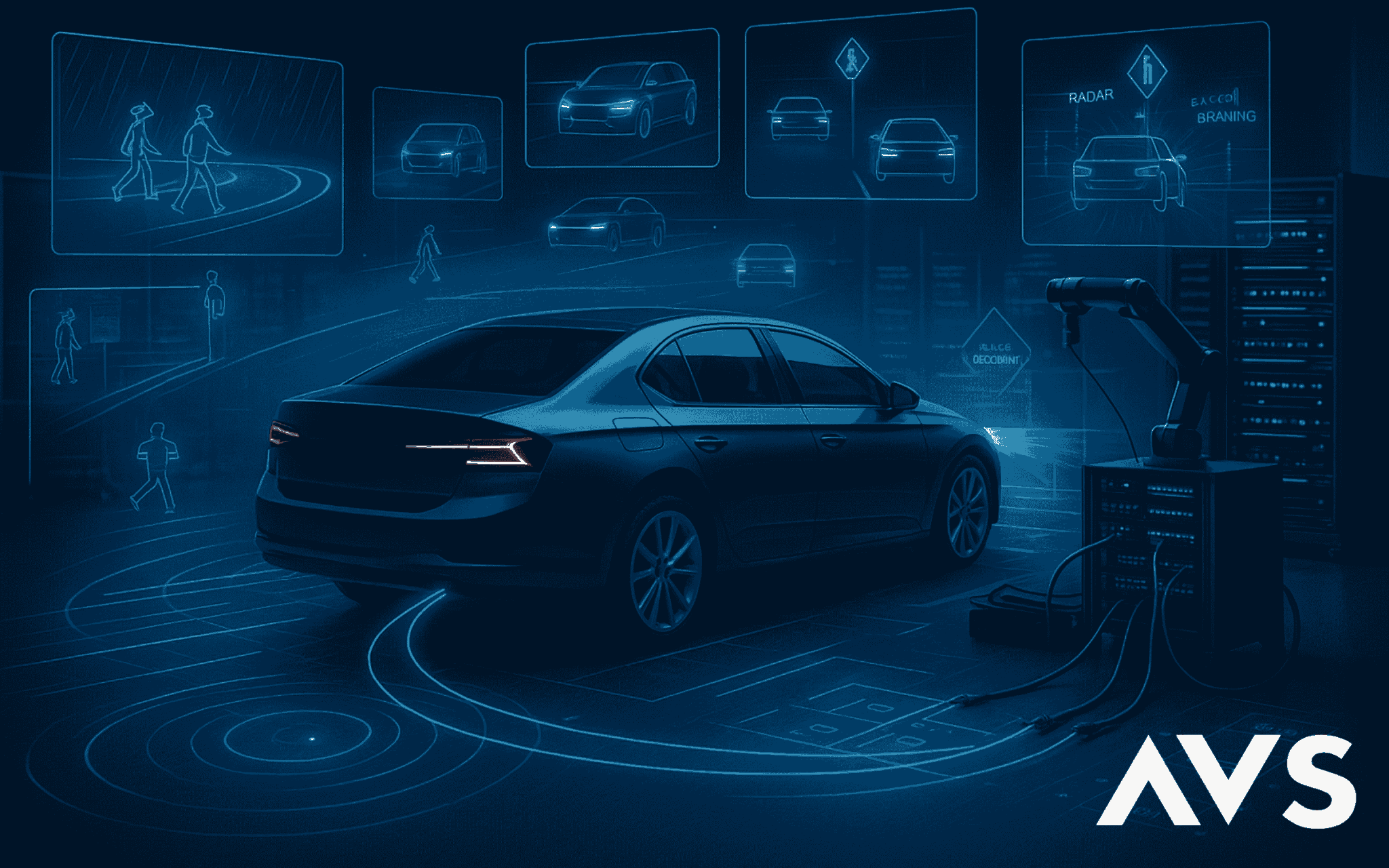
As Advanced Driver Assistance Systems (ADAS) become more complex, their validation must cover a vast and growing range of driving situations. Whether it’s an unexpected obstacle, degraded weather conditions, or a human behaving unpredictably, each scenario poses a challenge that must be anticipated during development.
Physically testing every single case is simply not feasible—too expensive, too time-consuming, and often impossible to replicate in the real world. That’s where Hardware-in-the-Loop (HIL) testing, powered by realistic simulation, becomes a game-changing solution for engineers.
Why simulate so many scenarios?
The number of test cases needed for ADAS has grown exponentially in recent years due to:
- The increasing variability of driving environments (weather, lighting, road types, traffic patterns)
- The need to cover edge cases and worst-case scenarios
- Compliance with international standards (Euro NCAP, ISO 21448 – SOTIF)
- The growing complexity of embedded software architectures
In this context, only virtual simulation can offer the breadth and reproducibility needed for full functional validation—without compromising deadlines or safety.
What role does HIL play in ADAS testing?
HIL testing involves connecting a real ECU (electronic control unit) to a real-time simulation environment. The goal is to observe how the system behaves in simulated conditions, as if it were physically embedded in the vehicle.
In the case of ADAS development, this allows engineers to:
- Validate closed-loop behavior under dynamic situations
- Test multi-ECU interactions, including sensor fusion and actuator control
- Expose the system to timing and signal variations that may trigger failure modes
With a tool like SCANeR™, these tests can be automated, scaled, and repeated across hundreds of diverse, mission-critical scenarios.
SCANeR™ et le test HIL : une intégration native
At AVSimulation, SCANeR™ is designed to work natively with leading HIL platforms, including dSPACE, NI, RTMaps, and custom real-time OS solutions.
Key advantages of SCANeR™ for HIL testing include:
- Real-time synchronization with ECU inputs and outputs
- High-fidelity simulation of vehicle dynamics, virtual sensors (lidar, radar, camera), traffic and weather
- Batch execution of large-scale scenario libraries
- Native support for NCAP, ISO 26262, and SOTIF requirements
This allows engineers to build a complete HIL loop where the ECU reacts to realistic driving conditions without ever leaving the lab.
Automating the execution of hundreds of critical scenarios
One of the greatest strengths of HIL simulation is its capacity for automation. SCANeR™ provides scripting tools and APIs that enable teams to:
- Run massive campaign-based testing
- Automatically inject variations (vehicle speeds, obstacle types, road surfaces, light and weather conditions)
- Monitor performance using custom pass/fail criteria (braking time, safe distance, trajectory deviation…)
For example: to validate an emergency braking system against pedestrian crossing, engineers can simulate 200 different scenarios (varying angle, speed, weather, surface friction, lighting, etc.) and precisely detect the limits of ECU performance.
Reduce risk, accelerate time to market
By combining high-fidelity simulation with automated HIL testing, OEMs and Tier 1s are able to:
- Accelerate the development and validation process
- Reduce physical test costs
- Increase confidence in functional safety and compliance
- Identify critical software edge cases earlier in the cycle
HIL-based simulation gives engineers the power to validate more, sooner, and more safely.
A proven approach in the ADAS industry
HIL testing with SCANeR™ is already in use across:
- Euro NCAP scenario validation (AEB, lane change, overtaking, vulnerable road users)
- Development of Level 2–4 autonomous driving functions
- Multi-ECU integration and performance testing in centralized E/E architectures
- Fine-tuning of sensor parameters for different use cases and regions
It also aligns perfectly with the move toward the Software Defined Vehicle (SDV), where software validation becomes a major strategic asset.