Developing Advanced Driver Assistance Systems (ADAS) comes with increasing testing challenges: detecting a pedestrian in poor lighting, anticipating a side collision, merging into dense traffic… These are all scenarios that are difficult — and sometimes dangerous — to reproduce on real roads.
This is where driving simulators become essential. Their strength lies in reproducing realistic driving situations in a controlled, safe, and repeatable environment — without the need for physical prototypes.
But not all simulators are created equal. When validating safety-critical systems, the level of dynamic, sensory, and behavioral realism becomes a determining factor in the relevance of the test.
Immersion: not just comfort, but technical necessity
A driving simulator is far more than a seat, steering wheel, and screen. It must accurately recreate the vehicle’s reactions, the driver’s sensations, and the visual and auditory environment.
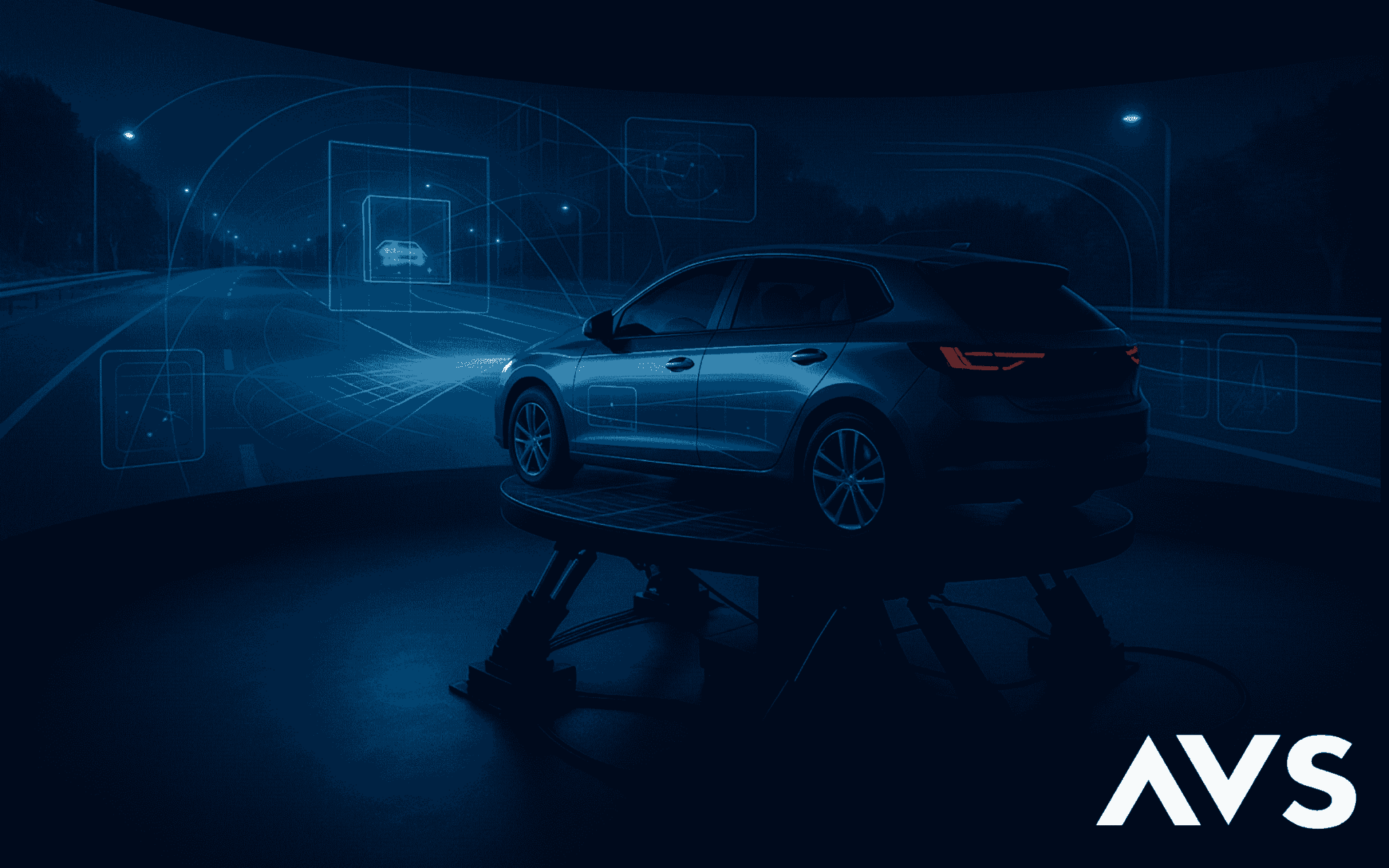
This is exactly what a full-cab simulator like SimDYN provides, with features such as:
- A 6-DOF motion platform, to replicate braking, acceleration, oversteer, understeer…
- A wide field-of-view display system with a 240° FOV (12K at 60 fps) for realistic depth, lighting, and contrast perception.
- High-fidelity force-feedback on the steering wheel and pedals via SCANeR’s Advanced FFB interface, plus a dedicated vibration system (0–100 Hz) integrated in the motion platform.
- Compatibility with real ECUs or sensor emulators for HIL testing
This level of realism is crucial when validating human-machine interactions, especially in ADAS takeover situations where milliseconds matter.
Safer, faster, more flexible validation
Road testing is time-consuming, costly, and dependent on weather, traffic, and regulation. Simulators, on the other hand, allow engineers to:
- Repeat the same scenario identically, for consistent validation
- Vary traffic, weather, lighting, pedestrian behavior at will
- Simulate edge cases and critical events with zero safety risk
- Gather high-resolution data to train or validate perception and control systems
Simulators are key components of a virtual validation chain, complementing open-road or proving ground tests.
👉 See also: ADAS & AV Validation with SCANeR™
A transversal tool for engineers, researchers, and testers
Modern simulators are not just for end-of-cycle testing. They’ve become cross-functional engineering platforms, used across the entire development lifecycle — from software architecture to sensor fusion calibration.
At AVSimulation, our driving simulators range meets all these needs:
- SimFLEX for flexible, compact setups
- SimEASY for compact, mobile all-in-one test stations
- SimDYN for immersive motion-based environments
- Custom configurations for research, UX studies, or training
All simulators are naturally integrated with SCANeR™, our multi-physics simulation platform tailored for ADAS and autonomous vehicle development.
Use case: simulating loss of grip with pedestrian detection
Imagine a challenging scenario: an autonomous vehicle is descending a mountain road in wet conditions. A pedestrian suddenly appears from behind a shadowed area. The ADAS must detect the pedestrian, react with emergency braking, and warn the driver if needed.
In a simulator, this can be reproduced in detail:
- A realistic road profile with slopes and curves
- Adverse weather (fog, rain, low visibility)
- Unpredictable pedestrian behavior
- Full synchronization with real ECUs or control algorithms
The result: engineers can evaluate system performance, identify failure modes, and fine-tune perception logic without putting anyone at risk.
From simulation to HIL/SIL integration
One of today’s key trends is to embed simulators into Hardware-in-the-Loop (HIL) or Software-in-the-Loop (SIL) testing workflows. This allows teams to:
- Connect real ADAS ECUs or sensor hardware to the simulation
- Inject realistic synthetic sensor data (camera, radar, lidar)
- Observe the true behavior of the system under near-real conditions
AVSimulation offers a full suite of HIL-compatible setups, with native interfaces to dSPACE, NI, RTMaps, and others.
Conclusion: a central tool for ADAS development
Driving simulators are no longer just for demonstrations or ergonomics studies. They have become essential tools for validating ADAS systems efficiently and safely.
With high immersion, total flexibility, and seamless integration into validation workflows, simulators allow engineers to test more complex scenarios, earlier in development, and with greater confidence.
At AVSimulation, our mission is to help OEMs, Tier 1s, and researchers bring ADAS and autonomous vehicles to life — faster and safer — through cutting-edge simulation.